
Your system says the part is available. The maintenance team needs it. But when someone reaches the warehouse, the shelf is empty.
This disconnect between inventory records and physical stock is commonly known as ghost stock. In mining and other asset-intensive operations, it can disrupt maintenance planning, delay work and reduce confidence in the data teams rely on every day.
For operations spread across multiple warehouses, workshops and remote sites, these discrepancies can be difficult to manage. One contributing factor is the delay between the completion of physical work and the corresponding update of inventory records.
How does ghost stock happen?
Consider a typical maintenance workflow.
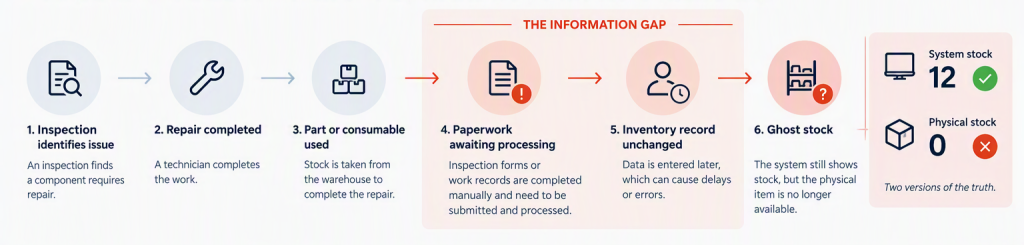
An inspection identifies an issue with a piece of equipment. A repair is required, so a technician completes the work using parts or consumables from the warehouse. Physically, the inventory has already changed.
Digitally, however, that change may not be reflected until someone completes the paperwork, returns it to the appropriate person and the information is manually entered into the relevant business or ERP system.
If the parts issue or consumption record is incomplete, misplaced or entered late, the discrepancy can continue. Leading to teams making decisions based on stock information that no longer reflects what is physically available.
The hidden cost of delayed information
Details may pass from a technician to an administrator before a stock transaction is processed. Each manual handover creates an opportunity for information to be delayed or entered incorrectly. Meanwhile, other teams continue working from the existing records.
A maintenance planner believes a component is available when it has already been consumed, procurement may not have received an accurate replenishment signal, or a technician may arrive to complete planned work, only to discover the required stock items aren’t there.
Closing the gap between field and system
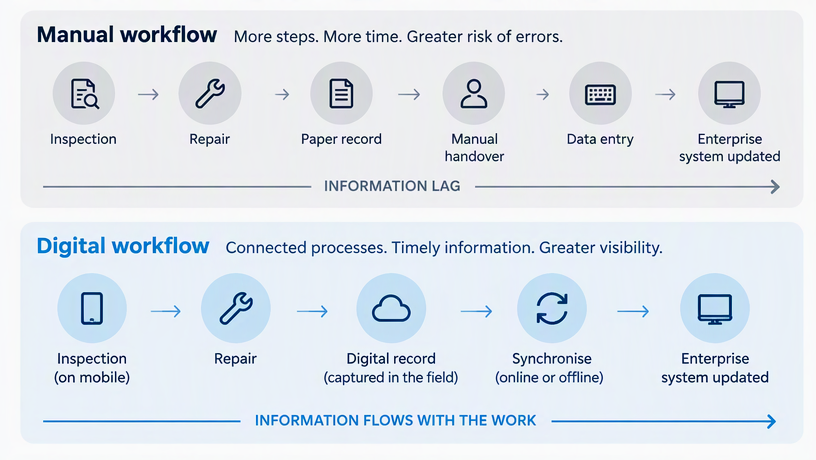
Digital workflows can help reduce that lag by capturing information closer to the point where the activity actually occurs.
Instead of completing a paper inspection that needs to be processed later, an inspector can record information digitally while performing the work. Where mobile tools support offline working, that information can still be captured in environments without reliable connectivity and synchronised once a connection becomes available.
But digitising an inspection is only the first step. If the resulting repair uses warehouse stock, the parts issue or consumption also needs to be recorded and passed through the appropriate inventory process. The value comes from connecting these activities, not simply replacing a paper form.
Connecting operational activity with enterprise data
Most asset-intensive businesses already operate multiple systems, each serving a different purpose.
An ERP platform may hold core inventory and enterprise data, while separate systems support inspections, completions, maintenance or other operational processes.
Where workflows and integrations are configured to support it, information captured during operational work can be validated and passed to the relevant enterprise system. This can reduce manual re-entry and the delay between a stock movement occurring and the inventory record being updated.
That distinction is important. Digitising the workflow is not the same as implementing another inventory system. It is about improving the quality, speed, and accessibility of the information that feeds the systems a business already relies on.
Bringing inventory records closer to operational reality
Eliminating every inventory discrepancy isn’t done by simply replacing paper with technology. It requires connected processes that reduce the delay between physical activity and the digital record.
For asset-intensive organisations, closing that gap can mean less administration, better visibility and greater confidence in the information used to plan and execute work.
When information moves with the work, there are fewer places for ghosts to hide.